
An intelligent stethoscope for detecting hypertrophic cardiomyopathy in cats
9 April 2026
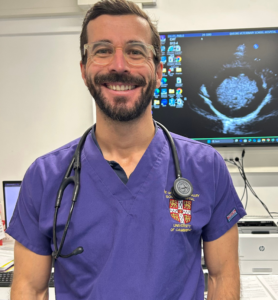
José Novo Matos received funding from BSAVA PetSavers and the Veterinary Cardiovascular Society to carry out a collaborative project developing an AI-assisted “intelligent stethoscope” to aid the diagnosis of HCM by GP vets.
What is our research about and why is it relevant?
Hypertrophic cardiomyopathy (HCM) is the most common heart disease in cats, affecting approximately one in seven cats in the general population.¹,² With around 12 million cats in the UK, this means as many as 1.8 million may be affected. While many cats remain asymptomatic, up to 30% will develop serious complications such as congestive heart failure, aortic thromboembolism, or sudden cardiac death.³,⁴ This could represent over half a million cats in the UK suffering from potentially life-threatening consequences of HCM.
The gold standard for diagnosing HCM is echocardiography,⁵ but this requires specialist expertise and equipment, limiting accessibility. There are far too few veterinary cardiologists in the UK to screen all cats potentially affected. As a result, many cats remain undiagnosed and at risk. A simpler, more accessible diagnostic tool could therefore have a major impact on early detection and care.
Auscultation is the first-line screening tool for heart disease, but in cats it poses significant challenges. While many cats with HCM have murmurs, up to 50% of healthy cats can also have innocent murmurs,¹,²,⁶ and murmurs may arise from non-cardiac causes such as anaemia. Moreover, between one-third and two-thirds of cats with HCM have no audible murmur at all.²,⁴ As a result, auscultation using a standard stethoscope has limited sensitivity for identifying HCM and is an unreliable screening tool.
This led us to ask: could we make stethoscopes smarter?
Developing an intelligent stethoscope
Our project is an exciting collaboration between veterinary cardiologists and engineers specialising in acoustics and biomedical technology.
We have previously developed an artificial intelligence (AI) algorithm to grade heart murmurs in dogs and assist in staging myxomatous mitral valve disease.⁷ In this new project, we are training an AI algorithm to detect and characterise heart murmurs in cats—specifically, to predict which murmurs are associated with HCM—using recordings collected with an electronic stethoscope.
Our ultimate goal is to develop an AI-assisted “intelligent stethoscope” that can help general practitioners identify cats at risk of HCM during routine clinical examinations. This tool could support vets in distinguishing innocent from pathological murmurs and deciding which cats should be referred for echocardiography.
How does the AI system work?
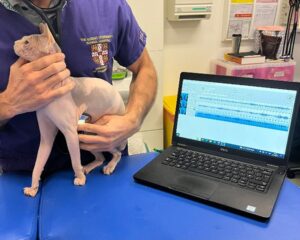
Cats referred for echocardiography to four UK referral centres are being enrolled in the study. For each cat, we record heart sounds using an electronic stethoscope and link these recordings to echocardiographic findings, allowing us to “teach” the AI what a normal and an abnormal heart sound looks and sounds like.
Each recording is transformed into a spectrogram – a visual representation showing how sound frequencies change over time, much like a heat map of the heartbeat (Figures 1–3). These patterns allow the AI system to recognise subtle differences in heart sounds.
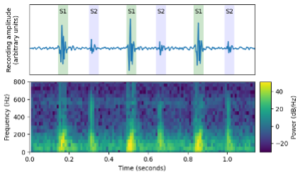
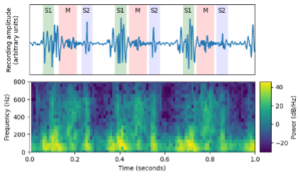
The AI model is trained to focus on the rhythmic pattern of the heartbeat, detecting murmurs linked to HCM while filtering out background noise or other bodily sounds. Once trained, the system will estimate the probability that a cat has HCM based solely on its heart sounds. We are also analysing whether murmur loudness and location can further improve detection accuracy.
What are the benefits of this research?
This project aims to provide vets with a simple, accessible, and objective method to detect and characterise abnormal heart sounds. The AI algorithm will ultimately be integrated into a user-friendly device suitable for both vets and nurses – either as part of a next-generation electronic stethoscope or as a smartphone app that pairs with Bluetooth stethoscopes.
This “intelligent stethoscope” could revolutionise feline cardiac screening by improving the detection of HCM in first-opinion practice, reducing the number of unnecessary referrals for innocent murmurs, and ensuring that cats most at risk are identified early. The result: better outcomes for cats and greater confidence for vets.
This work is a collaboration between the University of Cambridge Department of Veterinary Medicine (José Novo Matos, Catheryn Partington, Penny Watson, Nicole Cardoza), the Royal Veterinary College (Virginia Luis Fuentes, Eve Lo), Davies Veterinary Specialists (Lara Barron), Willows Veterinary Centre (Sid Sudunagunta, Sophie Goodrich, Shamanthi Shankar), and the University of Cambridge Department of Engineering (Anurag Agarwal).
How did I become interested in science?
My interest in research started during my cardiology residency, when I realised how essential clinical research is for advancing our field and improving patient care. Research allows us to deepen our understanding of disease and challenge existing boundaries, pushing veterinary medicine forward.
I have a particular interest in cardiomyopathies, which represent a heterogeneous group of diseases influenced by a complex interplay of genetic, environmental, and epigenetic factors. This multifactorial nature poses significant challenges for early diagnosis and for predicting disease progression. Importantly, feline cardiomyopathies closely mirror their human counterparts in terms of pathophysiology, clinical presentation, and genetic background, providing a robust One Health model for translational research. Comparative studies in cats therefore have the potential to yield critical insights into the mechanisms underlying cardiomyopathy across species, advancing both veterinary and human medicine.
Thinking about applying for PetSavers funding?
We are very grateful to BSAVA PetSavers for supporting this project, and we are working hard to turn this funding into meaningful data that will benefit both cats and clinicians.
For anyone in the UK considering applying for PetSavers funding—if you have a great idea, a passion for clinical research, and a drive to make a difference—I would strongly encourage you to apply. PetSavers funding offers a fantastic opportunity to advance veterinary knowledge and enhance the standard of care we provide to our patients.
By supporting innovative clinical research, PetSavers is helping shape the future of veterinary medicine! Donate here.
References
- Payne JR, Brodbelt DC, Luis Fuentes V. Cardiomyopathy prevalence in 780 apparently healthy cats in rehoming centres (the CatScan study). Journal of Veterinary Cardiology. 2015;17:S244–57.
- Paige CE, Abbott JA, Elvinger F, Pyle RL. Prevalence of cardiomyopathy in apparently healthy cats. Journal of the American Veterinary Medical Association 2009 p. 1398–403.
- Novo Matos J, Payne JR, Seo J, Luis Fuentes V. Natural history of hypertrophic cardiomyopathy in cats from rehoming centers: The CatScan II study. J Vet Intern Med. 2022;36(6):1900–12.
- Fox PR, Keene BW, Lamb K, Schober KA, Chetboul V, Luis Fuentes V, et al. International collaborative study to assess cardiovascular risk and evaluate long-term health in cats with preclinical hypertrophic cardiomyopathy and apparently healthy cats: The REVEAL Study. J Vet Intern Med. 2018;32(3):930–43.
- Luis Fuentes V, Abbott J, Chetboul V, Côté E, Fox PR, Häggström J, et al. ACVIM consensus statement guidelines for the classification, diagnosis, and management of cardiomyopathies in cats. J Vet Intern Med [Internet]. 2020 May 1 [cited 2024 Jun 5];34(3):1062–77. Available from: https://onlinelibrary.wiley.com/doi/full/10.1111/jvim.15745
- Franchini A, Abbott JA, Lahmers S, Eriksson A. Clinical characteristics of cats referred for evaluation of subclinical cardiac murmurs. J Feline Med Surg. 2021;23(8).
- McDonald A, Novo Matos J, Silva J, Partington C, Lo EJY, Luis Fuentes V, et al. A machine-learning algorithm to grade heart murmurs and stage preclinical myxomatous mitral valve disease in dogs. J Vet Intern Med [Internet]. 2024 Nov 1 [cited 2025 Sep 12];38(6):2994–3004. Available from: https://pubmed.ncbi.nlm.nih.gov/39431513/
About the author
BSAVA PetSavers receives no government funding, so is reliant on donations, gifts in Wills and fundraising. Support us by donating today: www.bsava.com/petsavers/donate