
CD44 expression in feline cholangiocarcinoma: A potential therapeutic target?
17 September 2026
Dr Alejandro Suarez-Bonnet, Senior Lecturer in Comparative Pathology at the Royal Veterinary College, was awarded funding from BSAVA PetSavers for a student research project to explore CD44 expression in feline cholangiocarcinoma with a view to determining its potential as a therapeutic target. Student Kathy Mu describes her research:
I was first introduced to feline cholangiocarcinoma research during my research project block last year, at the start of my final year of vet school. I wasn’t always interested in research, and especially not in histopathology, but I’ve come to really enjoy any work involving a microscope! I am eager to continue spreading my interest in pathology to fellow students and future colleagues. This research has definitely allowed me to refine my microscopy skills which will be invaluable in practice. I am extremely grateful to my supervisor Dr. Alejandro Suarez-Bonnet for his unwavering support and help throughout this project, and to BSAVA PetSavers for this unique opportunity to advance our knowledge in feline liver cancers.
Feline liver tumours: cholangiocarcinoma
The liver can be affected by primary or secondary tumours. Primary epithelial tumours can form from hepatocytes and from the bile duct epithelium, and both can be the origin of benign or malignant neoplasms. Benign bile duct neoplasms are classified as biliary adenomas, cholangiocellular adenomas, or biliary cystadenomas if the neoplasms form multiple, small, translucid cysts.
The malignant counterpart, cholangiocarcinoma (CCA), is a very aggressive form of liver cancer that unfortunately is frequently diagnosed at a very late state of the disease. Clinical signs caused by liver cancer in cats (including lethargy, anorexia, vomiting, weight loss, jaundice, and dyspnoea) are nonspecific and many times overlooked, which hampers an early clinical diagnosis in the absence of meticulous clinical examination that would require imaging (ultrasound or MRI) and histopathology (tissue samples from the liver).
Cholangiocarcinoma is a malignant neoplasm of the liver that forms from epithelial cells lining the bile ducts and can also grow from the gall bladder. In contrast to human medicine, where liver cancer causes are well studied with most cases attributed to chronic infection by hepatitis viruses, longstanding alcohol consumption and genetic syndromes, there is a complete lack of knowledge on the tumorigenesis of liver cancer in veterinary medicine. Additionally, the main current treatment option relies on surgical removal of the neoplasm if there is no evidence of local or distant metastasis, while medical adjuvant treatments are largely unexplored. This again contrasts with human medicine where treatment options are far more advanced and in continuous improvement.
The cell surface receptor CD44 is one of the most recent cell markers and therapeutic targets in human liver cancer, which prompted my supervisor Dr Alejandro Suarez-Bonnet and I to examine a cohort of cholangiocarcinoma tumour samples in the summer of 2025.
What did we find?
Twenty formalin-fixed, paraffin-embedded tissue blocks of feline cholangiocarcinomas were retrieved from the pathology archive of the RVC and subjected to immunohistochemical staining with a monoclonal antibody against CD44. The immunohistochemistry assay was performed in an automatic platform which allows standardization of the protocol and repeatability of the results. Stained tissue sections were evaluated by conventional optic microscopy, and a total expression score representing a quantification of the percentage of positive tumour cells and the staining intensity was given for each case, ranging from 0 (negative) to 9 (overexpression). Interestingly, and similar to human cholangiocarcinomas, CD44 was significantly overexpressed in feline cholangiocarcinomas compared to areas of histologically normal liver parenchyma (p < 0.001) (Figure 1). Normal liver parenchyma showed weak and heterogeneous expression of CD44 in cholangiocytes while neoplastic cells were strongly positive in the majority of cases (Figure 2). We hypothesize that this overexpression indicates that CD44 plays a role in the malignant transformation of normal bile duct epithelium. Our results also suggest that, similar to human cholangiocarcinomas, CD44 could be a potential therapeutic target in feline tumours. However, a much larger cohort is necessary to corroborate this hypothesis.
What does this mean for general practitioners?
Hepatic biopsies are commonly performed when liver disease is suspected, and are the gold standard diagnostic test to confirm or rule out liver neoplasm. However, there are challenging cases where neoplastic transformation is not clear on histological sections. CD44 should therefore be investigated as a marker that could increase our sensitivity to diagnose neoplastic transformations in the liver.
Why consider BSAVA PetSavers?
We are wholeheartedly grateful for the generous support of BSAVA PetSavers, whose funding has allowed us to cover the purchase of the antibody and laboratory consumables. Importantly, their support has also given us the opportunity to share these new findings and push us to continue investigating this field. I would encourage veterinary students to find an inspiring mentor to elaborate a research proposal while considering BSAVA PetSavers as a funding opportunity. PetSavers also supports veterinary students and veterinarians to publish their findings and present them to the wider veterinary community, and represents an invaluable funding opportunity for members of this community with an interest in research.
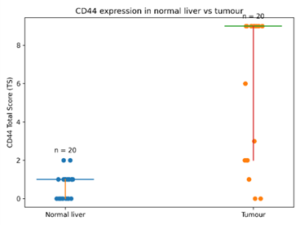
Figure 1. Immunohistochemical total scores for normal liver and cholangiocarcinoma cases.
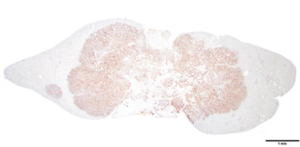
Figure 2. Feline cholangiocarcinoma. Neoplastic cells markedly and diffusely overexpress CD44 (brown colour) while the rest of the hepatic parenchyma is negative for CD44 staining.
About the author
Originally from Montreal, Canada, Kathy obtained her first undergraduate degree at Concordia University in molecular biology. Through her veterinary undergraduate research and the PetSavers student project at the RVC, she has discovered a new interest for histopathology. She will soon be starting a small animal rotating internship back home. In her free time, she enjoys discovering new restaurants, staying active, and spending time with her orange and white cat, Kimchi.
Help us fund more veterinary clinical research
BSAVA PetSavers receives no government funding, so is reliant on donations, gifts in Wills and fundraising. Support us by donating today: www.bsava.com/petsavers/donate